The pharmacist in charge is no longer just the guarantor of the proper use of the medication. He is also a business leader, manager, employer, and a public health actor. This multiplication of responsibilities has profoundly transformed his role: today, risk management has become a strategic skill.
The first challenge remains the safety of patients. Every year, several hundred million boxes of medication are dispensed in France. An error in dispensing, a medication interaction, or a poor dosage can have serious consequences. The Good Dispensing Practices, defined in particular in Article R.4235-48 of the Public Health Code, also require a pharmaceutical analysis of each prescription and a continuous approach to improving quality.
But the risks go far beyond the mere act of dispensing. Pharmacists must cope with increasingly demanding regulations while ensuring the continuity of care. Supply disruptions, which currently affect more than 5,000 medications, including hundreds of drugs of major therapeutic interest, require teams to find alternatives, contact prescribers, and support patients on a daily basis.
The pressure is also human with 4 million patients returning to French pharmacies every day. In 2025, 468 attacks on pharmacists were reported to the National Council of the Order, nearly three-quarters of which were verbal violence. At the same time, approximately 37 % of the practicing pharmacists would be at high risk of burnout, a consequence of an increasing workload that combines health, regulatory, economic, and managerial responsibilities.
To this is added the role of employer. Occupational risks – handling, musculoskeletal disorders, biological exposures or falls – account for 110,000 days lost per year and an average of 85 days of absence due to an accident at work. They require a genuine prevention policy, while the growing dependence on digital tools brings up new cybersecurity and business continuity issues.
Ultimately, the job of a qualified pharmacist no longer consists solely of dispensing the right medicine to the right patient. It also involves anticipating, arbitrating, organizing, and securing an exercise that has become particularly complex. Risk management is no longer a regulatory requirement: it is now a determining factor in the quality, performance, and sustainability of pharmacies.
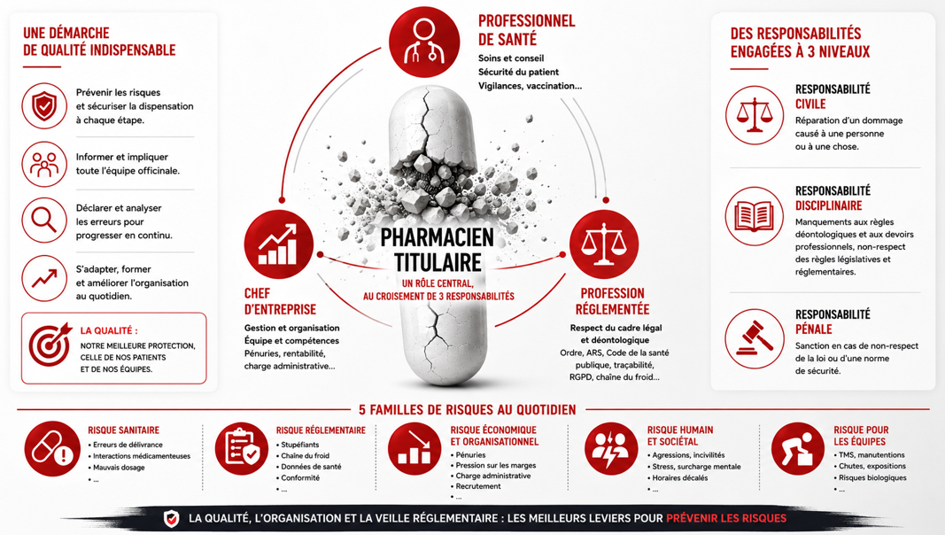
Impressive. Pharmacist with several responsibilities: facing 5 families of risks and 3 levels of responsibility assumed.
Bibliography references
National Institute of Research and Safety. Health and Safety in Pharmacy. 2023 https://www.inrs.fr/metiers/sante-aide-personne/pharmacie/les-risques-du-metier.html (website accessed on July 16, 2026)
Antoine Beal. Dissertation in progress. Professional burnout in pharmacy: the SEPHARM study: a cross-sectional analysis of professional burnout syndrome among pharmacy practitioners in the Pays de la Loire region. https://cpcms.fr/associations/angers/wp-content/uploads/2025/03/17704F.pdf (website accessed on July 16, 2026)
Health Insurance. Pharmacy of the pharmacy. 2025. https://www.ameli.fr/entreprise/sante-travail/votre-secteur/commerces-services/pharmacie#:~:text=La%20formation%20en%20gestion%20des,cl%C3%A9s%20pour%20%C3%A9viter%20ces%20risques. (. Website accessed on July 16, 2026)
Order of Pharmacists. 2025 review. Attacks by pharmacists and actions by the order. https://www.ordre.pharmacien.fr/mediatheque/fichiers/la-securite-des-pharmaciens-bilan-2025(website accessed on July 16, 2026).
Order of Pharmacists. Summary. Developing prevention in France. 15 proposals to strengthen the role of pharmacists. 2018 https://www.ordre.pharmacien.fr/mediatheque/rapport-developper-la-prevention-en-france. (. Website accessed on July 16, 2026)